
Oh, my darling grand-grand mother, she was one of these. And she spoke with the wolves. And we were a few in the pack. She was so nice.
Therefore, my name, by that chance, belongs to her.
Growing up in her lap was a tremendously fierce but terribly kind experience. Which is a sign one receives. And cannot, by any means, let go.

Like one of our dogs today. He still hangs onto the tyre of that old car that has been hanged around that tree and is just not letting go. He thinks he needs to prove himself to the pack. And he accepted the challenge. He will be onto that tyre to the end of days, and will still not let go. The wolf pack will observe. But it is still a dog we're talking about. He will never be able to become a wolf but he has the chance to proove himself worthy being considered as the one. Which also isn't so bad. Except for the tyre. The tyre itself is older than universe and is the one that puts the greater Saturn into his place. And he won't let it go until the greater Saturn does not give up his rings. And when about is this going to happen?
"I have a calendar", said kindly my feral shadow cat. Then she miaouwed for really long. And I wasn't sure whether it's a mijaouw or just a mijaouwed laughter straight from her mijaouwing heart.
"Love is the law. Love in its most lawless state."

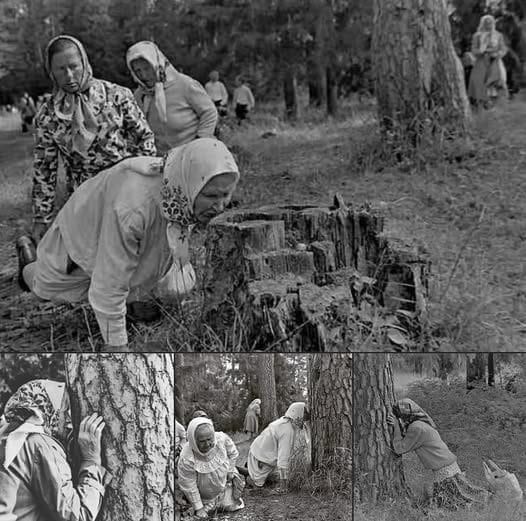
The veneration of trees and sacred groves among the Slavs is well documented in medieval sources. Kozma of Prague (Cosmas Pragensis) in his Chronica Boemorum (early 12th century) mentions that the pre-Christian Slavs revered natural sacred spaces, including groves, springs, and trees, where rituals were performed. Although Cosmas writes from a Christian perspective and critically portrays pagan practices, his chronicle is one of the key narrative sources for early Slavic religion in Central Europe.
A similar testimony appears in the writings of Helmold of Bosau (12th century), particularly in his Chronica Slavorum. Helmold describes the religious life of the Polabian Slavs (Western Slavs living between the Elbe and Oder rivers), noting their sanctuaries located in forests and sacred enclosures. While he focuses more on temples and cult images (such as those of Svantevit in Arkona), he also records the importance of sacred groves and natural cult sites. His account is considered an important, though polemical, source for pre-Christian Slavic religion.
For the Eastern Slavs, references to tree veneration appear in hagiographic literature. The Life of Constantine of Murom (Житие Константина Муромского), a medieval Russian text, mentions the persistence of pagan practices among the population, including reverence toward natural objects. Such texts were written to emphasize the triumph of Christianity, and therefore often preserve indirect evidence of earlier religious customs.
Although sometimes attributed in popular literature, there is no direct surviving text of John Chrysostom that specifically documents Slavic tree worship; however, early Christian authors more generally condemned the practice of praying in groves or venerating trees among pagan peoples. Canonical and ecclesiastical texts from medieval Rus’ repeatedly prohibited “prayers at trees, springs, and stones,” which indicates the persistence of these customs long after Christianization.
Archaeological and ethnographic research supports these written testimonies. Sacred groves (often referred to in scholarship as nemeton-type sanctuaries in comparative Indo-European studies, though that term is Celtic) were common across Indo-European cultures. In the Slavic context, oak trees in particular were associated with the thunder god Perun. Later folklore materials collected in the 19th century in Russia, Ukraine, and Belarus record practices such as tying cloth to branches, leaving offerings, or performing vows near certain trees believed to possess healing or protective power.
Importantly, elements of this tradition survived into Christian practice in transformed ways. In many Slavic regions, trees near churches, chapels, or holy springs became objects of popular veneration. Pilgrims sometimes tied ribbons to branches or prayed near specific trees associated with saints. Ethnographers note that these practices represent continuity in ritual behavior rather than formal Christian doctrine.
The Sharzhenga (Russian: Шарженга, Шарженьга) is a river flowing through the Nyuksensky, Babushkinsky, and Nikolsky Districts of Vologda Oblast in Russia. The Vologda region is rich in documented folk traditions, including seasonal rituals connected to forests and agricultural cycles. While a specific historical medieval record mentioning women praying to trees near the Sharzhenga River has not been identified in primary chronicles, ethnographic parallels from northern Russia confirm that sacred trees and forest rituals were part of local religious life into the modern period.
Thus, the image of Russian women praying to trees near the Sharzhenga River fits within a broader, historically attested pattern of Slavic reverence for sacred groves and trees — a practice that was gradually transformed but never entirely erased by Christianization.
.
visual: Russian women near the Sharshenga River in Nyuksensky, Babushkinsky, and Nikolsky Districts of Vologda Oblast, praying to trees in sacred groves.

And she is golden.
So is, the wound.

And she is golden.
So is, the wound.

And she is golden.
So is, the wound.

a simple question remains: does anyone understand the potential meaning and the consequences of this (example: pictured/unedited/today/any day). does anyone even remotely understands the immediate consequences, and by these, the causes, and by these the predictions of escalations of the consequences if projected, let's say - 7 years into the future? is it possible that no one understands, or that there are some, that understand but do not want to give it a chance to grasp onto their mind the complete implications of this (example: pictured/unedited/today/or any day)
It is a state of absolute fundamentalism.
Face***k? Face***k!
Disclaimer: We were but only a few in the pack and later, as before, and into the future, they wanted to destroy us and they have used every possible means to eradicate our presence and wipe us out. Which on itself is a good thing by itself. But the reality is, it cannot be wiped. It cannot be destroyed. It cannot be removed. It cannot be altered. We are the wolves. You are, the prey. Nothing will ever change except for the piece by piece you will accept the peace and make peace within yourselves. Then, we will enter and tear you apart by the kindest of the feast. An eye, for an eye. A tooth, for a tooth. A piece, by piece. Peace anyone?